Fire Door Inspection Regulations UK: Complete 2026 Guide
Last updated: 25 March 2026
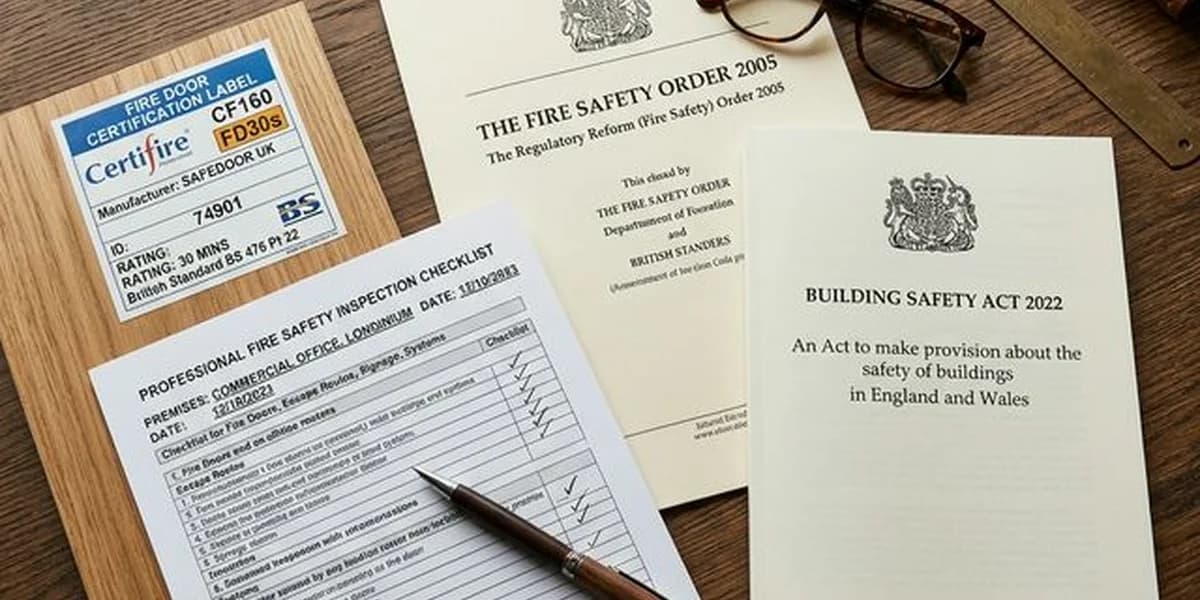
UK fire door inspection regulations are primarily governed by the Regulatory Reform (Fire Safety) Order 2005, the Fire Safety Act 2021, the Fire Safety (England) Regulations 2022, and the Building Safety Act 2022. Residential buildings over 11 metres must have fire doors in common parts inspected quarterly and flat entrance doors inspected annually. All non-domestic premises must maintain fire doors in working order as part of their fire risk assessment. Non-compliance can result in unlimited fines and imprisonment.
Key Legislation Governing Fire Door Inspections
The Regulatory Reform (Fire Safety) Order 2005 (FSO 2005)
The FSO 2005 is the foundational piece of fire safety legislation in England and Wales. It places a duty on the "responsible person" — typically the building owner, landlord, or employer — to carry out a fire risk assessment and ensure that fire safety measures, including fire doors, are properly maintained. The Order applies to virtually all non-domestic premises and the common areas of residential buildings. Under the FSO 2005, fire doors must be maintained in working order, which means they must close fully on their own, have intact intumescent strips and cold smoke seals, and maintain the correct gap tolerances specified by BS 8214.
The Fire Safety Act 2021
The Fire Safety Act 2021 clarified the scope of the FSO 2005, confirming that it applies to the structure, external walls, and flat entrance doors of multi-occupied residential buildings. Before this Act, there was legal ambiguity about whether the FSO 2005 covered these elements. The clarification was a direct recommendation of the Grenfell Tower Inquiry Phase 1 Report and resolved disputes about whether flat entrance doors fell within the responsible person's duties.
The Fire Safety (England) Regulations 2022 (FSER 2022)
The FSER 2022, which came into force on 23 January 2023, introduced the most specific fire door inspection requirements in UK legislation. For residential buildings over 11 metres in height, the responsible person must ensure that all fire doors in common parts (corridors, stairwells, lobbies) are checked at least every three months, and all flat entrance doors are checked at least once a year. The regulations also require information sharing with residents about fire doors in their building and the provision of a building floor plans to the fire and rescue service.
The Building Safety Act 2022
The Building Safety Act 2022 introduced additional requirements for higher-risk buildings — residential buildings over 18 metres (roughly 7 storeys) or with at least 2 residential units. It created the Building Safety Regulator (within the Health and Safety Executive), mandated the appointment of an Accountable Person and Principal Accountable Person for each higher-risk building, and required a Safety Case approach that includes comprehensive fire door asset registers with inspection records. The Act also introduced the concept of a "golden thread" of building safety information that must be maintained throughout the building's lifecycle.
BS 8214: Fire Door Assemblies
BS 8214 is the British Standard that provides guidance on the selection, installation, inspection, and maintenance of timber fire door assemblies. While not legislation in itself, BS 8214 is referenced by fire risk assessors, insurance companies, and courts as the benchmark standard for fire door maintenance. It recommends six-monthly professional inspections and provides detailed criteria for assessing fire door compliance, including gap tolerances, closer performance, seal condition, and labelling requirements.
Inspection Frequency Requirements
| Building Type | Legislation | Minimum Frequency | What's Inspected |
|---|---|---|---|
| Residential >11m — common parts | FSER 2022 | Quarterly | All fire doors in corridors, stairwells, lobbies |
| Residential >11m — flat entrance doors | FSER 2022 | Annually | Individual flat entrance fire doors |
| Commercial premises | FSO 2005 + BS 8214 | Six-monthly (best practice) | All fire doors as identified in fire risk assessment |
| Healthcare / Hospitals | FSO 2005 + HTM 05-02 | Annually (more frequent in high-risk areas) | All fire doors including ward, theatre, and corridor doors |
| Care homes | FSO 2005 + CQC requirements | Six-monthly (recommended) | All fire doors including bedroom doors, corridor doors |
| Schools / Education | FSO 2005 + BB100 | Annually | All fire doors as identified in fire risk assessment |
| Higher-risk buildings >18m | Building Safety Act 2022 | As per Safety Case (typically quarterly) | Full fire door asset register with documented inspections |
Who Can Inspect Fire Doors?
The FSER 2022 and FSO 2005 refer to a "competent person" requirement for fire door inspections but do not mandate specific certifications. In practice, this means fire door inspections can be carried out at two levels:
- Basic visual checks can be carried out by trained building staff (caretakers, facilities managers, building managers) who have completed appropriate training. These checks confirm that doors close properly, seals appear intact, and there is no visible damage.
- Full professional surveys should be conducted by inspectors with recognised certifications such as FDIS, BM TRADA Q-Mark, IFC, or FIRAS certification. These surveys assess compliance with BS 8214, measure gap tolerances, test closer performance, and produce detailed reports with remediation recommendations.
Penalties for Non-Compliance
Non-compliance with fire door regulations can result in serious legal consequences for the responsible person. Fire and rescue authorities have a range of enforcement powers:
- Enforcement notices requiring deficiencies to be remediated within a specified timeframe
- Prohibition notices that can immediately restrict or close a building where there is an imminent risk to life
- Prosecution with unlimited fines for organisations and individuals
- Imprisonment of up to two years for the responsible person in cases of serious non-compliance
Since Grenfell, fire authorities have increased enforcement activity significantly. The Home Office reported a 40% increase in enforcement notices and prosecutions related to fire safety between 2018 and 2024, with fire door deficiencies cited as a contributing factor in approximately 70% of enforcement actions in residential buildings.
Timeline of UK Fire Door Regulation Changes
Regulatory Reform (Fire Safety) Order 2005
Replaced previous fire safety legislation with a single framework. Introduced the 'responsible person' concept and fire risk assessment requirement.
Grenfell Tower Fire (14 June 2017)
72 people killed. Subsequent inquiry highlighted systemic failures in fire door maintenance and inspection across the UK building stock.
Grenfell Tower Inquiry Phase 1 Report
Recommended mandatory fire door inspections at regular intervals and clarification of the responsible person's duties regarding flat entrance doors.
Fire Safety Act 2021 (29 April 2021)
Clarified that the FSO 2005 scope includes building structure, external walls, and flat entrance doors in multi-occupied residential buildings.
Fire Safety (England) Regulations 2022 (commenced 23 January 2023)
Introduced quarterly fire door checks in common parts and annual flat entrance door checks for residential buildings over 11 metres.
Building Safety Act 2022 (28 April 2022)
Created the Building Safety Regulator. Introduced Accountable Person duties, Safety Case requirements, and the golden thread concept for higher-risk buildings.
Approved Document B Amendments (2026)
Updated fire safety design guidance with enhanced compartmentation requirements and revised fire door specifications for new buildings.
Find a Certified Inspector
Ensure your building meets current fire door regulations by working with a certified inspector. Our directory lists verified fire door inspection companies across all UK regions, with certification status, services offered, and customer reviews.
Frequently Asked Questions
What legislation requires fire door inspections in the UK?
The main legislation is the Regulatory Reform (Fire Safety) Order 2005 (FSO 2005), the Fire Safety Act 2021, the Fire Safety (England) Regulations 2022 (FSER 2022), and the Building Safety Act 2022. Together these create a comprehensive framework requiring fire door maintenance, inspection, and documentation in both residential and commercial buildings.
How often must fire doors be inspected in residential buildings?
Under the FSER 2022, fire doors in common parts of residential buildings over 11 metres must be checked at least quarterly. Flat entrance doors must be checked at least annually. These are minimum legal requirements — BS 8214 recommends six-monthly professional inspections as best practice.
Who is the 'responsible person' for fire door compliance?
The responsible person is typically the building owner, landlord, managing agent, or employer. In residential blocks, this is usually the freeholder or the management company. They are personally liable for ensuring fire safety compliance, including fire door maintenance.
Can a building manager do fire door checks themselves?
Building managers can carry out basic visual checks — confirming doors close properly, seals appear intact, and there is no visible damage. However, full fire door surveys assessing compliance with BS 8214 and fire performance standards should be conducted by a competent person, ideally with FDIS or equivalent certification.
What are the penalties for non-compliance with fire door regulations?
Penalties include enforcement notices, prohibition notices (which can close a building), prosecution with unlimited fines, and in serious cases imprisonment of up to two years for the responsible person. Following Grenfell, enforcement has increased significantly.
Do fire door regulations apply in Scotland and Wales?
Scotland has its own legislation under the Fire (Scotland) Act 2005 with similar requirements. Wales falls under the FSO 2005 and FSER 2022 for buildings in scope, though the Welsh Government has additional guidance through the Building Safety in Wales Programme. Northern Ireland operates under the Fire and Rescue Services (Northern Ireland) Order 2006.
What changed after the Grenfell Tower fire?
The Grenfell Tower fire in June 2017 triggered a complete overhaul of UK fire safety legislation. The Fire Safety Act 2021 clarified the scope of the FSO 2005 to include building structure and external walls. The FSER 2022 introduced mandatory fire door inspection frequencies. The Building Safety Act 2022 created the Building Safety Regulator and imposed additional duties on higher-risk buildings.
What is the Building Safety Act 2022 and how does it affect fire doors?
The Building Safety Act 2022 introduced new requirements for higher-risk buildings (residential buildings over 18 metres or 7+ storeys). It requires the appointment of an Accountable Person and a Building Safety Manager, mandates a Safety Case approach including fire door asset registers, and empowers the Building Safety Regulator to take enforcement action for non-compliance.
Sources & References
- Regulatory Reform (Fire Safety) Order 2005
- Fire Safety Act 2021
- Fire Safety (England) Regulations 2022
- Building Safety Act 2022
- BS 8214:2016 — Timber-based fire door assemblies
- Grenfell Tower Inquiry Phase 1 Report
Related Guides
Fire Door Inspection Cost in the UK (2026 Guide)
Fire door inspection costs range from £3–12 per door. Compare prices by building type and get quotes from certified UK inspectors.
Fire Door Inspection Checklist
Fire door inspection checklist: gaps, seals, hinges, closers, signage, glazing, and labels. Know when to call a professional.
Fire Door Inspection Training & Courses
Compare fire door inspection courses: FDIS, BM TRADA, NAFDI, IFC. Costs, duration, and career paths for UK inspectors.