How Often Should Fire Doors Be Inspected?
Published 30 March 2026
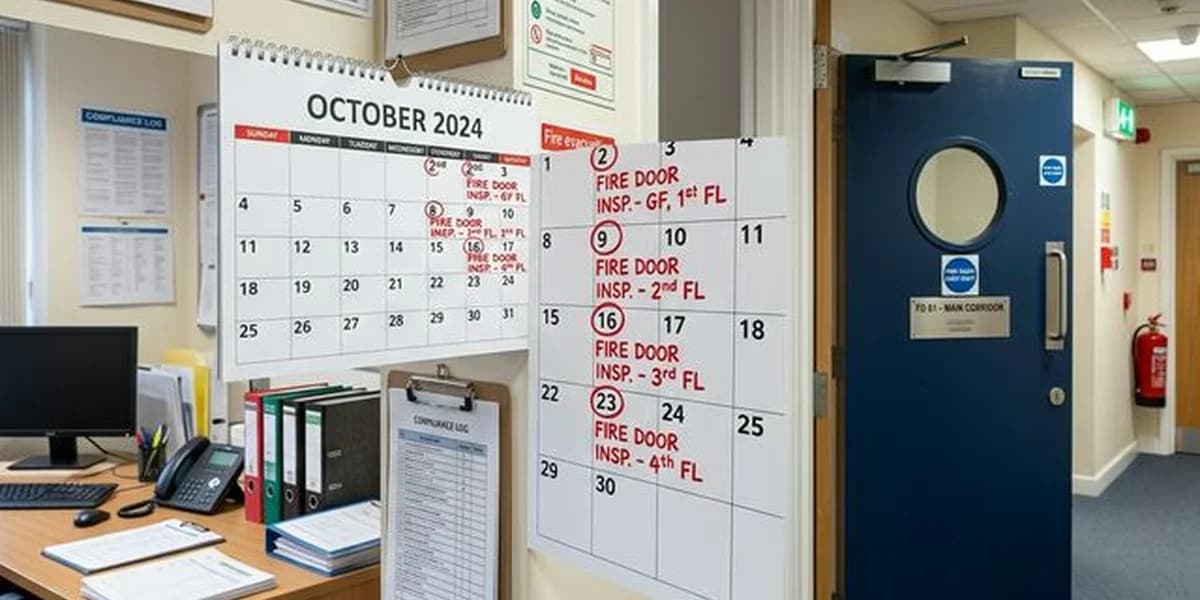
Fire doors in high-rise residential buildings (over 11 metres) in England must be inspected at least every three months under the Fire Safety (England) Regulations 2022. For other non-domestic premises, there is no single fixed interval — but industry guidance recommends inspections every six months, with annual checks as an absolute minimum. This article explains the legal requirements, recommended frequencies by building type, and what happens during an inspection.
Legal Requirements in England
The Fire Safety (England) Regulations 2022 (FSER 2022) introduced the first statutory requirement for routine fire door checks. Under Regulation 10, the responsible person for a high-rise residential building (over 11 metres or with seven or more storeys) must ensure:
- Quarterly checks of all fire doors in communal areas (corridors, lobbies, stairwells)
- Annual checks of flat entrance doors that open onto communal areas
- Best efforts to inspect fire doors within individual flats, subject to resident co-operation
For buildings that fall outside the high-rise definition, the Regulatory Reform (Fire Safety) Order 2005 (RRO) still applies. The RRO requires the responsible person to maintain fire safety measures — including fire doors — but does not specify exact intervals. This is where industry guidance fills the gap.
Inspection Frequency by Building Type
The table below summarises recommended inspection frequencies based on current legislation and industry best practice (BS 8214:2016):
| Building Type | Minimum Frequency | Regulation |
|---|---|---|
| High-rise residential (over 11m) | Every 3 months (communal); annually (flat entrance doors) | FSER 2022, Reg 10 |
| Care homes | Every 6 months (quarterly recommended) | RRO 2005 + CQC guidance |
| Hospitals & healthcare | Every 6 months | RRO 2005 + HTM 05-02 |
| Schools & education | Every 6–12 months | RRO 2005 |
| Commercial offices | Annually | RRO 2005 |
| Hotels & hospitality | Every 6 months | RRO 2005 |
These are minimum recommendations. High-traffic buildings, premises with vulnerable occupants, or buildings with a history of door damage should consider more frequent inspections.
Who Can Inspect Fire Doors?
The FSER 2022 does not mandate a specific qualification, but the government’s explanatory guidance states that inspections should be carried out by a “competent person.” In practice, this means someone with demonstrable knowledge of fire door standards and construction. Industry-recognised certifications include:
- FDIS (Fire Door Inspection Scheme) — the most widely recognised third-party scheme
- BM TRADA Q-Mark — product certification and installer accreditation
- FIRAS — installer certification under Warrington Fire
- IFC Certification — independent fire door installer scheme
Using a certified inspector provides an audit trail and gives building managers confidence that inspections meet the required standard. Browse certified inspectors in our directory.
What Happens During an Inspection?
A typical fire door inspection follows the criteria set out in BS 8214:2016 and checks the following elements against the fire door inspection checklist:
- Door leaf condition — warping, damage, delamination
- Intumescent strips and smoke seals — present, intact, correctly fitted
- Hinges — three or more, CE-marked, securely fixed
- Self-closing device — closes fully from any angle
- Gap tolerances — 3mm ±1mm on all edges; max 8mm at threshold
- Glazing — fire-rated, properly beaded, no cracks
- Signage — “Fire Door Keep Shut” present where required
- Frame and threshold integrity
Each door receives a pass, advisory, or fail rating. Failed doors must be remediated promptly — the responsible person cannot wait until the next scheduled inspection to address critical defects.
Consequences of Not Inspecting
Failure to inspect fire doors is an offence under the Fire Safety Order. Enforcement officers from local fire and rescue services can issue:
- Informal notices requiring remedial action within a set timeframe
- Enforcement notices for significant non-compliance
- Prohibition notices preventing building use until defects are resolved
- Criminal prosecution — fines are unlimited, and custodial sentences are possible for serious breaches
Beyond legal penalties, a non-functional fire door can allow fire and smoke to spread unchecked, putting lives at risk. Regular inspection is the most cost-effective way to maintain compliance and protect building occupants. For more on costs, see our fire door inspection cost guide.
Finding a Qualified Inspector
Our directory lists over 750 verified fire door inspection companies across the UK, filterable by certification, service type, and building type. Browse all inspectors or find inspectors in your area:
Frequently Asked Questions
Do fire doors in flats need to be inspected?
Yes. Under the FSER 2022, flat entrance doors that open onto communal areas in buildings over 11 metres must be inspected at least annually. The responsible person should also make best efforts to inspect fire doors within individual flats, though this requires resident co-operation.
Can a building manager carry out fire door checks themselves?
Building managers can carry out basic visual checks between formal inspections — for example, confirming doors close fully and seals are intact. However, formal compliance inspections should be conducted by a competent person with relevant qualifications such as FDIS certification.
What is the difference between a fire door check and a fire door inspection?
A “check” typically refers to the routine quarterly visual assessment required by FSER 2022. An “inspection” is a more detailed assessment against BS 8214:2016 standards, often resulting in a formal report. In practice, many people use the terms interchangeably. See our guide on fire door inspection vs survey for a more detailed comparison.
Last updated: 30 March 2026
Author: Find Fire Door Inspector Editorial Team
Sources & References
- Fire Safety (England) Regulations 2022 — legislation.gov.uk
- FSER 2022 Explanatory Guidance — GOV.UK
- BS 8214:2016 — Timber-based fire door assemblies